AI-Empowered Integrated Sensing and Communication (ISAC) for Industrial Applications
The need for ISAC in 6G
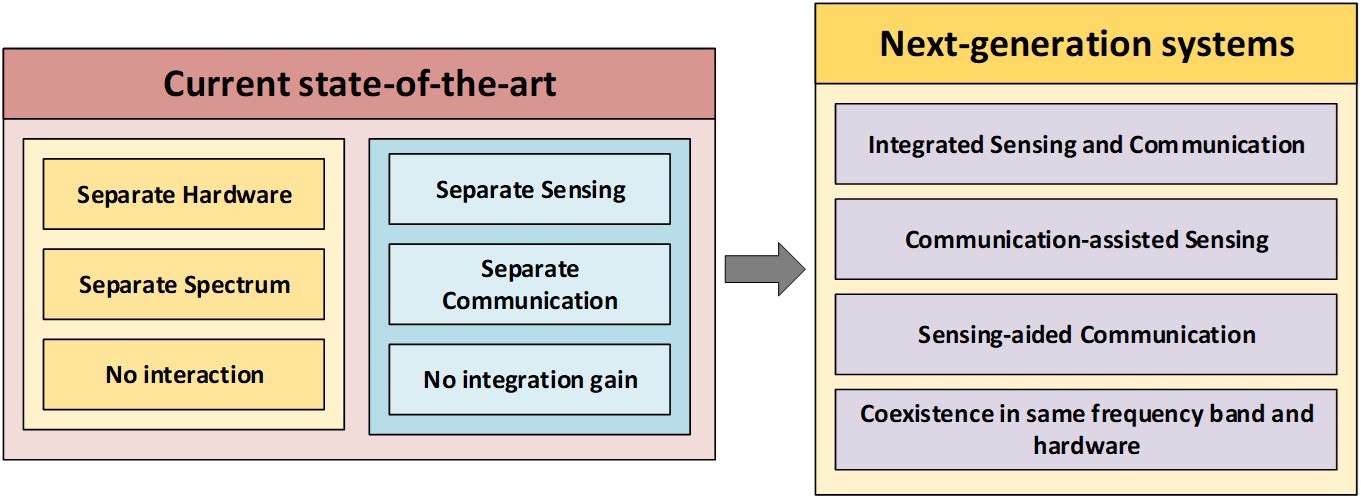
The ITU's IMT-2030 (6G) framework envisions networks that do more than delivering bits: they must understand and interact with the physical world in real time.
Hence, IMT-2030 explicitly calls for integration of sensing and AI-related capabilities into communications so networks can provide functions such as
precise positioning, environment awareness, and 3-D mapping for automated transport, digital twins, and industrial automation.
In the same recommendation, the integrated sensing and communication (ISAC) is highlighted as a key enabler for future use cases.
It has been established that sensing is a first-class requirement alongside classic throughput/latency targets in the 6G era.
In parallel, 3GPP's 5G-Advanced Release 19 is already laying technical groundwork that bridges toward 6G,
including a study on channel modeling for ISAC and another on higher mid-band spectrum (7-24 GHz) that is particularly relevant for fine-grained spatial sensing with large arrays.
These studies are positioned as direct bridges to 6G topics, underlining the growing standardization momentum behind ISAC.
 |
What ISAC is?
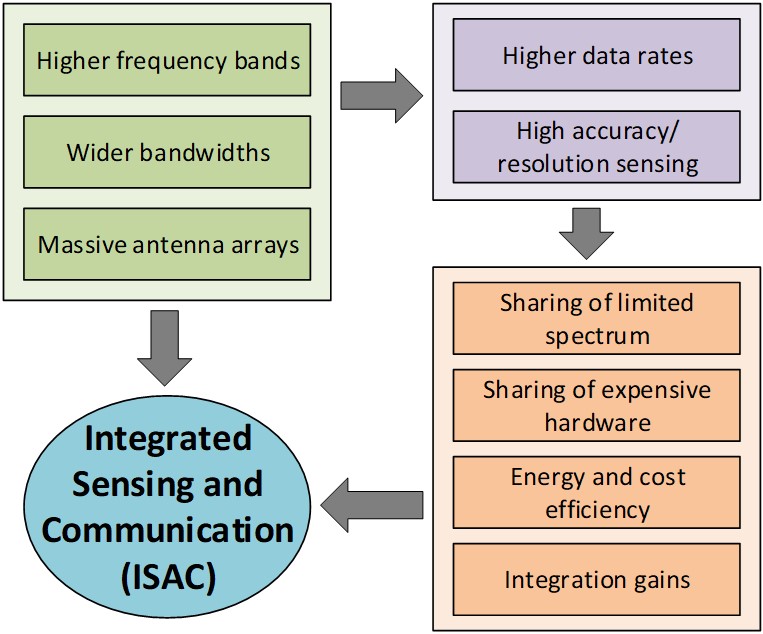
ISAC denotes the joint design and co-existence of communication and sensing within the same radio system, reusing hardware, spectrum, waveforms, and signal processing to deliver both data services and sensing functionalities. Rather than operating separate radar and communication stacks, ISAC seeks dual-functional waveforms, transceivers, and network protocols.
 |
Benefits of ISAC
Spectrum Efficiency: Shared frequency bands reduce spectrum scarcity.
Hardware Utilization: Common hardware for sensing and communication lowers costs.
Energy Efficiency: Integrated operations reduce power consumption.
Enhanced Capabilities: High-resolution localization, imaging, and environment reconstruction.
Applications of ISAC
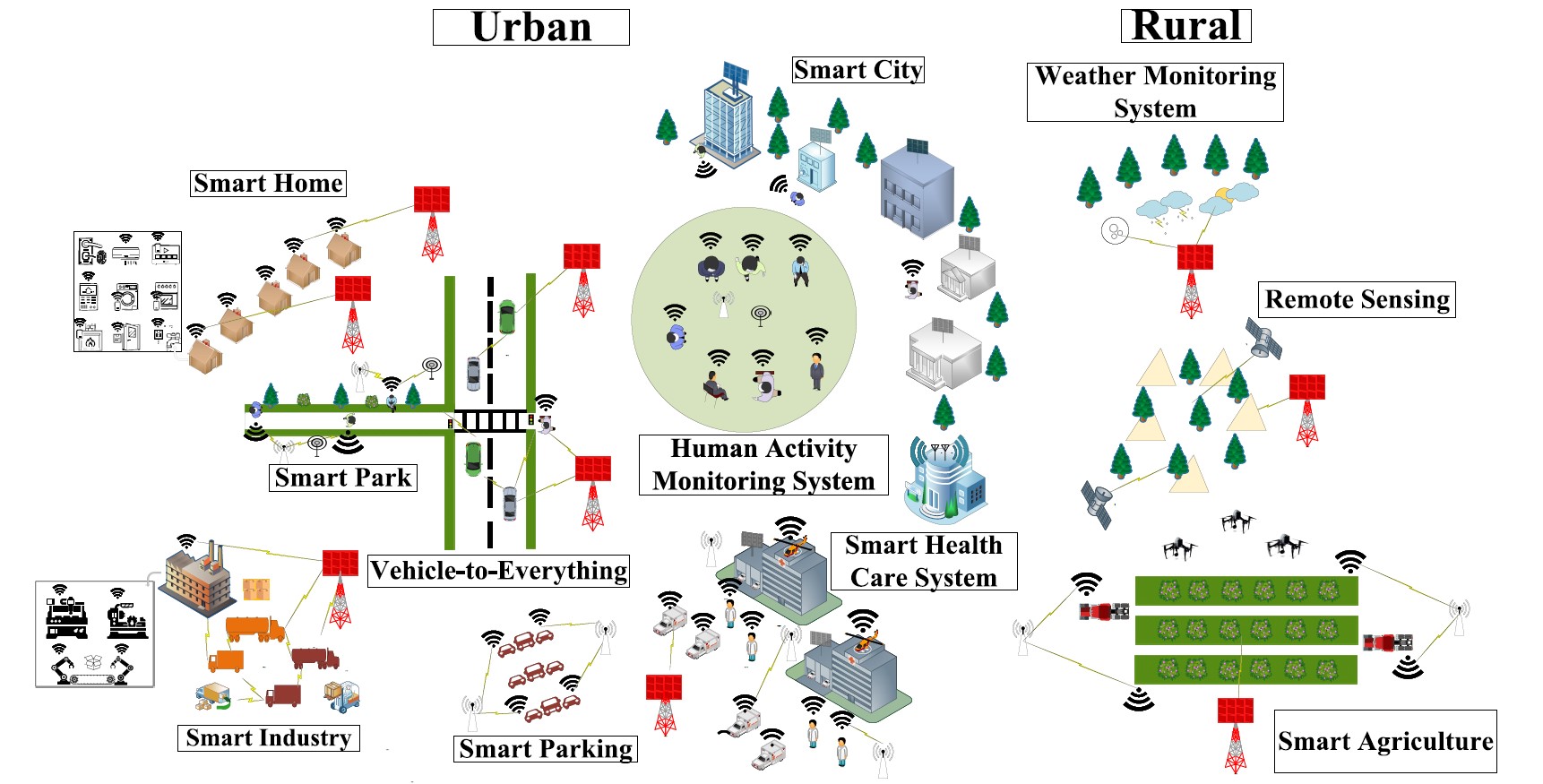
Automated driving and smart mobility: Lane-level positioning, high-resolution obstacle detection, and real-time 3D mapping using cellular infrastructure as a perception layer for vehicles and roadside units.
Industrial automation and robotics: Environment awareness for autonomous guided vehicles, safety zones, and precise motion control on factory floors (low latency, high reliability, high-accuracy localization).
Extended reality (XR) and digital twins: Synchronized sensing-assisted pose estimation and semantic mapping to support immersive experiences and the creation/maintenance of digital twins.
Smart cities and public safety: Crowd flow monitoring, infrastructure health, and environmental monitoring (e.g., micro-Doppler for activity recognition) using shared cellular assets.
UAVs and logistics: Joint communication, tracking, and collision avoidance for drone corridors and airborne platforms.
Healthcare and well-being: Contactless vitals monitoring and activity recognition-where regulatory/policy considerations allow-integrated with connectivity services.
Diverse applications of ISAC are shown in the below Figure.
 |
ISAC performance metrics
In 6G, the same radio signals that carry data will also enable sensing and radar capabilities, allowing networks to detect, track, and map their surroundings while sustaining reliable communications. Embedding sensing into the existing infrastructure unlocks the above mentioned benefits of ISAC. The following are some typical performance metrics which are used in both communication and radar systems.
Communication metrics
Energy per bit to noise power spectral density ratio
Spectral efficiency
Bit error rate
Achievable data rate
Outage probability
Sensing/Radar metrics
Cramer Rao Bound (CRB)
Range resolution
Doppler resolution
Ambiguity function
Probability of detection
MSE
Probability of false alarm
Receiver operating characteristics
Challenges in ISAC Design
ISAC designs are intrinsically a multi-objective optimization problems because a single waveform, power budget, and hardware chain must satisfy two distinct performance classes that often pull in opposite directions. Communication favors high data-rate and low-error transmission whereas sensing seeks precise range, angle, and Doppler estimation. Increasing transmit bandwidth or symbol diversity, for instance, benefits sensing resolution but can raise peak-to-average power ratio and impair communication robustness; conversely, tightening modulation to boost throughput may degrade the ambiguity function and blur target returns. So, improving one metric can directly worsen the other. As a result, ISAC waveform, beamforming, and resource-allocation tasks are typically cast as Pareto-optimal trade-offs, solved via weighted-sum, e-constraint, or pareto optimization to navigate the conflicting landscape and reveal the attainable frontier between communication quality of service and sensing accuracy.
A general multi-objective optimization problem formulation
ISAC problems naturally fall under the category of multi-objective optimization, where multiple conflicting objectives must be optimized at the same time. These problems can be mathematically represented with objective functions \(f_i(x)\), subject to equality constraints \(g_i(x)\) and inequality constraints \(h_k(x)\), where x denotes the vector of decision variables.
\[ \begin{equation*} \mathrm{Minimize} \;\;\;\;\;\;\;\;\;\;\;\;\; \mathbf{f}(x) = \left[f_1(x), f_2(x), \cdots. f_i(x)\right] \\ \!\!\!\!\!\!\!\!\!\! \!\!\!\!\! \!\!\!\!\!\!\!\!\!\! \mathrm{Subject \; to} \;\;\;\;\;\;\;\;\;\;\;\;\;\;\;\;\; g_j(x) = 0, j = 1,2 \cdots, m, \\ \;\;\;\;\;\;\;\;\;\;\;\;\;\;\;\;\;\;\; h_k(x) \leq 0, k = 1,2 \cdots ,n, \end{equation*} \]
Limitations of Traditional Approaches
Traditional model-based designs face significant hurdles:
Unknown Optimal Algorithms: Optimal solutions for joint sensing and communication are frequently unavailable.
Computational Complexity: Known algorithms are often too complex for real-time implementation.
These limitations necessitate AI-driven ISAC solutions that can find the right balance between the communication and sensing tasks and provide sub-optimal yet feasible solutions.
4. AI-Empowered ISAC Designs
AI-driven approaches address the limitations of traditional methods by leveraging data-driven learning and adaptability, making them ideal for complex industrial ISAC applications.
AI Techniques for ISAC
Key AI techniques include:
Artificial Neural Networks
Generative Adversarial Networks (GANs): GANs consist of a generator and discriminator that compete to create realistic synthetic data. In ISAC, GANs generate accurate near-field channel models, capturing complex propagation characteristics.
Active Multi-Task Deep Learning: This approach trains a single model to handle multiple tasks, such as signal demodulation and target echo estimation, improving efficiency by sharing representations across tasks. crucial for dynamic industrial settings.
5. Completed Research Tasks on ISAC
Below are some completed works on ISAC.