Trade-off Between Probability of Detection and Achievable Rate in Near-Field ISAC Systems
 |
Context & Motivation
In mmWave and sub-THz bands, Extra-Large Antenna Arrays (ELAAs) are needed to offset high path-loss.
Large apertures push more users/targets into the near-field region, where spherical-wave modeling is required.
Using far-field models/precoders for near-field users leads to performance loss.
Study focuses on the trade-off between communication (achievable rate) and sensing (probability of detection) in near-field ISAC.
Main Contributions
Derivation of achievable user rates for ELAA-based near-field ISAC with Maximal Ratio Transmission (MRT) precoding.
Design of two target detectors:
Case-1: Known BS-target channel (Neyman-Pearson detector).
Case-2: Unknown BS-target channel (GLRT detector with channel estimation).
Development of a transmit power optimization algorithm to maximize the weakest-user rate while ensuring a minimum sensing power.
Quantification of the rate-detection trade-off by varying sensing power allocation.
System Model
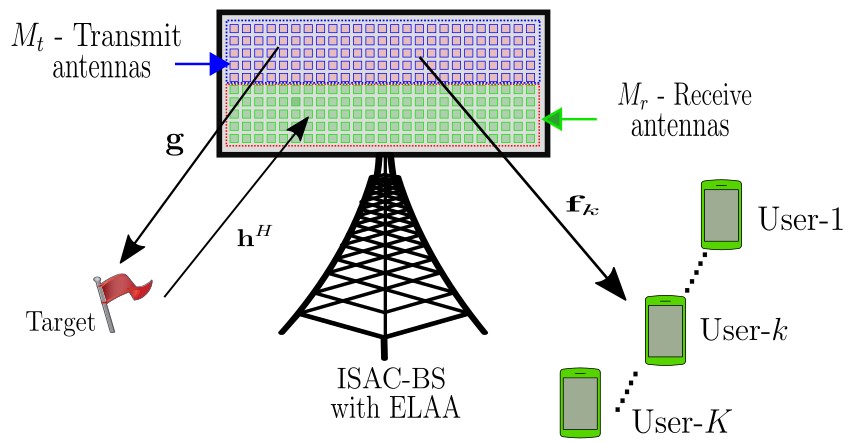
ELAA BS with \(M_T\) transmit and \(M_R\) receive antennas serves \(K\) single-antenna users and senses a single target.
Uniform rectangular planar array; all users/targets located within Fraunhofer distance (near-field).
Superimposed sensing and communication signals transmitted.
Performance Metrics
Communication: Achievable downlink user rate based on SINR.
Sensing: Probability of detection (\(P_D\)) and probability of false alarm (\(P_{FA}\)) from NP and GLRT detectors.
ROC curves used to visualize sensing performance.
Optimization
Max-min fairness power allocation across users and sensing.
Constraints include total power, non-negativity, and minimum sensing power.
Solved via geometric programming.
Key Numerical Results
Trade-off curves show that increasing sensing power allocation improves PD but reduces achievable rate.
Channel knowledge impact: Known sensing channel significantly boosts PD, especially at low PFA.
Array size effect: Increasing number of receive antennas improves PD.
Channel model mismatch impact: Using far-field precoders for near-field users causes large rate losses-up to 92.89% with \(M_T\)=400 at 30 dB SNR
More transmit antennas worsen the loss from far-/near-field mismatch; higher \(K\) also increases loss.
Conclusions
Accurate near-field precoder design is critical for ELAA-based ISAC.
MRT-based approach with optimized power allocation can balance rate and detection performance.
ELAAs can enhance the rate detection trade-off when properly leveraging near-field channel knowledge.
References
1. M. A. Jayasinghe, J. K. Dassanayake, and G. Amarasuriya, “Trade-off Between Probability of Detection and Achievable Rate in Near-Field ISAC Systems”, in Proc. IEEE Int. Conf. Commun. (ICC), Montreal. Canada, Jun. 2025.