Near-Field Performance of ELAA-Based ISAC
 |
Context & motivation
6G's newly allocated mid-band (FR3: 7-15 GHz) offers better propagation propagation
With smaller bandwidths than mmWaves, 6G base stations are needed to be equipped with extremely large aperture arrays (ELAAs) to boost spatial multiplexing gains at these frequencies.
Then, the large apertures push the near-field boundary to hundreds of meters, making spherical-wave channel models necessary.
Existing near-field ISAC works often ignore effects such as near-field scatterers, spatial correlation, partial visibility, non-wide sense stationarity (non-WSS), and imperfect CSI.
Main contributions
Develops a comprehensive near-field performance analysis for ELAA-based ISAC that includes:
Spatially correlated Rician fading due to near-field scatterers.
Generalized spatial correlation model for non-uniform antenna spacing.
Partial visibility regions to model non-WSS.
Imperfect CSI estimation.
Clutter and extended targets in sensing.
Proposes a computationally-efficient conjugate precoding-based superimposed ISAC waveform.
Formulates and solves a transmit power allocation problem to maximize the minimum user rate while satisfying a sensing power threshold.
System setup
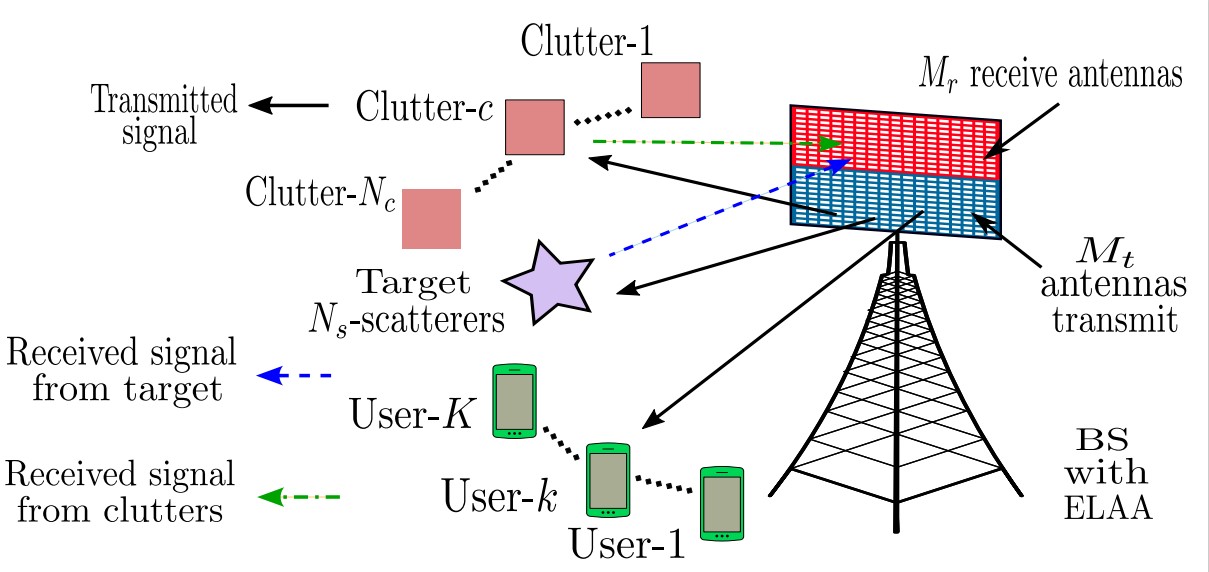
ELAA base station with \(M_T\) transmit and \(M_R\) receive antennas, serving \(K\) single-antenna users and sensing one extended target.
Communication channels modeled with near-field spatially correlated Rician fading.
Sensing model includes extended targets and multiple clutter sources.
CSI acquired via uplink pilots; precoders built from estimated CSI.
Performance metrics
Communication: Achievable user rates derived under imperfect CSI using statistical downlink CSI.
Sensing: Optimal Neyman-Pearson (NP) detector derived, with performance measured via ROC (probability of detection vs false alarm rate).
Optimization
Jointly optimizes user and sensing power allocation.
Objective: maximize weakest-user SINR while meeting a minimum sensing power constraint.
Solved as a convex problem via geometric programming.
Key numerical findings
Partial visibility and spatial correlation significantly degrade user rates.
Near-/far-field channel model mismatch in precoder design can cause notable performance loss.
Increasing sensing threshold improves detection probability but reduces achievable communication rate, showing a clear sensing-communication trade-off.
Larger receive arrays improve sensing performance even with lower sensing power.
Conclusion
Accurate near-field modeling is essential for ELAA-based ISAC in FR3 bands.
Conjugate precoding with optimized power allocation can balance communication and sensing.
ELAAs can leverage spatial multiplexing gains to improve the fundamental ISAC trade-off when near-field effects are properly considered.
References
1. J. K. Dassanayake and G. Amarasuriya, “Near-Field Performance of ELAA-Based ISAC,” in Proc. IEEE Int. Conf. Commun. (ICC), Montreal, Canada, Jun. 2025.